
AI Photo Editor
📸 AI Photo Editor: Transform Your Images with Artificial Intelligence
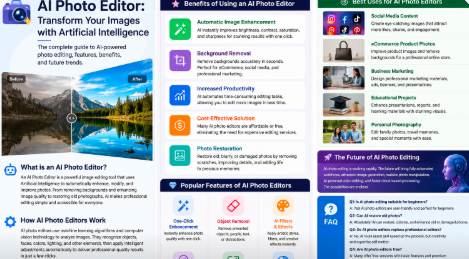
🤖 What is an AI Photo Editor?
Artificial Intelligence has dramatically transformed the digital content industry, and one of the most impactful innovations is the AI Photo Editor. An AI Photo Editor is a software application that uses advanced machine learning algorithms, computer vision technology, and artificial intelligence models to automatically analyze and improve images.
Traditional photo editing often requires extensive technical knowledge and hours of manual adjustments. AI-powered editors simplify this process by identifying image elements such as people, objects, backgrounds, lighting conditions, and color tones. The software then makes intelligent improvements automatically, helping users create professional-quality images within seconds.
Whether you are a photographer, graphic designer, eCommerce business owner, marketer, influencer, blogger, or casual smartphone user, AI photo editing tools offer an efficient solution for producing visually appealing content without extensive editing experience.
✨ How AI Photo Editors Work
AI photo editors rely on sophisticated technologies that enable computers to understand and process visual information much like humans do.
🔍 Key Technologies Behind AI Photo Editors
🧠 Machine Learning:
Machine learning forms the foundation of modern AI photo editing software. Through continuous training on millions of images, machine learning models learn patterns related to lighting, composition, image quality, and object recognition. This enables AI systems to automatically identify areas requiring improvement.
The technology continuously improves as it processes more images, making future edits increasingly accurate. Machine learning allows AI editors to recommend enhancements, remove imperfections, optimize image sharpness, and adjust exposure levels automatically. This reduces the need for manual editing and ensures consistent image quality across large collections of photographs.
👁️ Computer Vision:
Computer vision allows AI systems to “see” and interpret visual content. This technology helps software recognize faces, landscapes, products, animals, text, and various objects within an image.
By understanding image composition, computer vision enables features such as facial recognition, background removal, object detection, and intelligent cropping. Businesses use computer vision extensively for product photography, while content creators benefit from faster and more accurate editing workflows.
🎨 Image Recognition:
Image recognition helps AI editors identify specific objects, colors, textures, and patterns within photographs. The technology categorizes visual elements and applies targeted improvements accordingly.
For example, AI can recognize skies, buildings, vegetation, skin tones, and clothing. It then adjusts these elements individually for optimal visual appeal. This precision allows users to achieve professional results without manually selecting editing areas.
⚡ Automated Enhancement:
Automated enhancement technology evaluates image quality instantly and applies multiple corrections simultaneously. This includes exposure balancing, color correction, contrast optimization, sharpness enhancement, and noise reduction.
The result is a significantly improved image that maintains a natural appearance. Automated enhancement is particularly useful for photographers and businesses handling large volumes of images daily.
🤖 Generative AI:
Generative AI represents the newest generation of photo editing technology. It can create entirely new image elements, remove unwanted objects seamlessly, expand image backgrounds, and generate realistic visual content.
This technology opens new possibilities for creative professionals by reducing design limitations and accelerating content production workflows.
🚀 Benefits of Using an AI Photo Editor
🎨 Automatic Image Enhancement:
Automatic image enhancement is among the most valuable benefits offered by AI photo editors. The software instantly analyzes brightness, contrast, color balance, exposure, and sharpness to improve overall image quality.
Instead of spending significant time adjusting individual settings, users can achieve professional-looking results with a single click. This capability is especially useful for businesses, social media marketers, and photographers who process hundreds of images regularly. Automatic enhancement also helps maintain consistency across image collections, improving brand presentation and visual appeal.
🖼️ Background Removal:
Background removal technology has become one of the most popular AI-powered editing features available today. AI can accurately separate subjects from backgrounds without requiring manual tracing or masking.
This functionality is particularly beneficial for online stores, product photography, professional headshots, and marketing campaigns. Clean background removal improves product visibility, creates more attractive visual presentations, and allows users to replace backgrounds with customized designs suitable for various purposes.
📈 Increased Productivity:
AI photo editors dramatically reduce editing time by automating repetitive tasks. What previously required hours of manual work can now be completed in minutes.
Content creators, photographers, agencies, and businesses benefit from faster project completion and increased operational efficiency. By automating technical editing tasks, professionals can focus more on creativity, strategy, and content development rather than spending excessive time on image corrections.
💰 Cost-Effective Solution:
Hiring professional photo editors or purchasing expensive editing software can be costly for individuals and small businesses. AI photo editing tools provide an affordable alternative while still delivering high-quality results.
Many platforms offer free versions or budget-friendly subscription plans. This makes professional-level editing accessible to startups, freelancers, entrepreneurs, and hobbyists who may have limited resources but still require high-quality visual content.
🔄 Photo Restoration:
AI-powered photo restoration technology helps revive old, damaged, blurry, or faded photographs. Advanced algorithms reconstruct missing details, remove scratches, improve sharpness, and restore original colors.
Families, historians, museums, and photography enthusiasts use AI restoration tools to preserve valuable memories and historical images. The ability to restore aging photographs has become one of the most impressive applications of artificial intelligence in digital imaging.
⭐ Popular Features of AI Photo Editors
🌟 One-Click Enhancement
One-click enhancement simplifies the editing process by applying multiple improvements simultaneously. Users can instantly optimize brightness, color accuracy, contrast, and image clarity. This feature is ideal for beginners and professionals seeking quick results without sacrificing quality.
🧹 Object Removal
AI object removal technology eliminates unwanted people, objects, shadows, reflections, and distractions from images. The software intelligently fills removed areas with realistic content that blends naturally with the surrounding environment.
🎭 AI Filters and Effects
AI-powered filters transform ordinary images into creative visual masterpieces. Users can apply artistic styles, cinematic effects, digital paintings, sketches, cartoons, and aesthetic enhancements with remarkable accuracy and realism.
😊 Face Retouching
Face retouching features automatically improve portraits by smoothing skin, reducing blemishes, whitening teeth, enhancing eyes, and optimizing facial lighting. AI ensures edits appear natural rather than overly processed.
📏 Image Upscaling
Image upscaling technology increases image resolution while preserving detail and clarity. Businesses frequently use AI upscaling to improve product photos, print materials, and marketing assets.
🎨 Color Correction
Color correction tools analyze image tones and adjust colors for a more balanced and visually appealing appearance. Proper color correction enhances professionalism and improves viewer engagement.
📱 Best Uses for AI Photo Editors
📸 Social Media Content
AI photo editors help influencers, brands, and content creators produce visually engaging social media content that attracts attention and increases engagement across multiple platforms.
🛒 eCommerce Product Photos
Online retailers use AI editing tools to create clean, professional product images that improve customer trust and boost conversion rates.
🏢 Business Marketing
Marketing teams leverage AI-enhanced visuals for advertisements, websites, presentations, email campaigns, and promotional materials.
🎓 Educational Projects
Students and educators use AI image editing tools to improve presentations, research materials, online courses, and educational resources.
👨👩👧 Personal Photography
Families and photography enthusiasts utilize AI editing solutions to enhance vacation photos, family portraits, and personal memories quickly and effectively.
🔮 Future of AI Photo Editing
Artificial intelligence continues evolving rapidly, and future photo editing solutions will become even more intelligent and automated. Advanced AI systems will likely offer real-time image enhancement, personalized editing recommendations, automated content generation, and deeper integration with video editing platforms.
Future developments may also include fully autonomous editing workflows capable of understanding creative intent and producing customized visual outcomes without human intervention. As technology advances, AI photo editing will continue transforming digital creativity across industries.
🏆 Conclusion
AI Photo Editors have revolutionized image editing by making professional-quality enhancements accessible to everyone. From automatic image enhancement and background removal to advanced restoration and generative AI capabilities, these tools offer remarkable efficiency and creative flexibility.
Businesses, photographers, marketers, content creators, and everyday users can benefit from faster workflows, lower costs, and superior image quality. As artificial intelligence continues advancing, AI photo editors will play an increasingly important role in digital content creation and visual communication worldwide.
❓ Frequently Asked Questions (FAQs)
1️⃣ What is the best use of an AI Photo Editor?
AI Photo Editors are commonly used for image enhancement, background removal, object removal, photo restoration, portrait retouching, and content creation for social media and business marketing.
2️⃣ Can AI Photo Editors replace professional photographers?
No. AI photo editors enhance productivity and simplify editing, but professional photographers still provide creative expertise, artistic vision, and specialized photography skills.
3️⃣ Are AI Photo Editors suitable for beginners?
Yes. Most AI photo editors are designed with user-friendly interfaces that allow beginners to achieve professional-quality results with minimal experience.
4️⃣ Can AI restore old photographs?
Yes. Modern AI restoration tools can repair scratches, improve sharpness, restore faded colors, and reconstruct damaged image details effectively.
5️⃣ Do AI Photo Editors improve image quality?
Yes. AI can enhance brightness, contrast, color balance, sharpness, and resolution while reducing image noise and imperfections.
6️⃣ Are AI Photo Editors useful for e-commerce businesses?
Absolutely. AI tools help create professional product photos, remove backgrounds, standardize images, and improve online store presentation.
7️⃣ Is AI photo editing the future of digital photography?
AI is expected to become a core component of digital photography, providing smarter automation, advanced editing capabilities, and improved creative workflows.